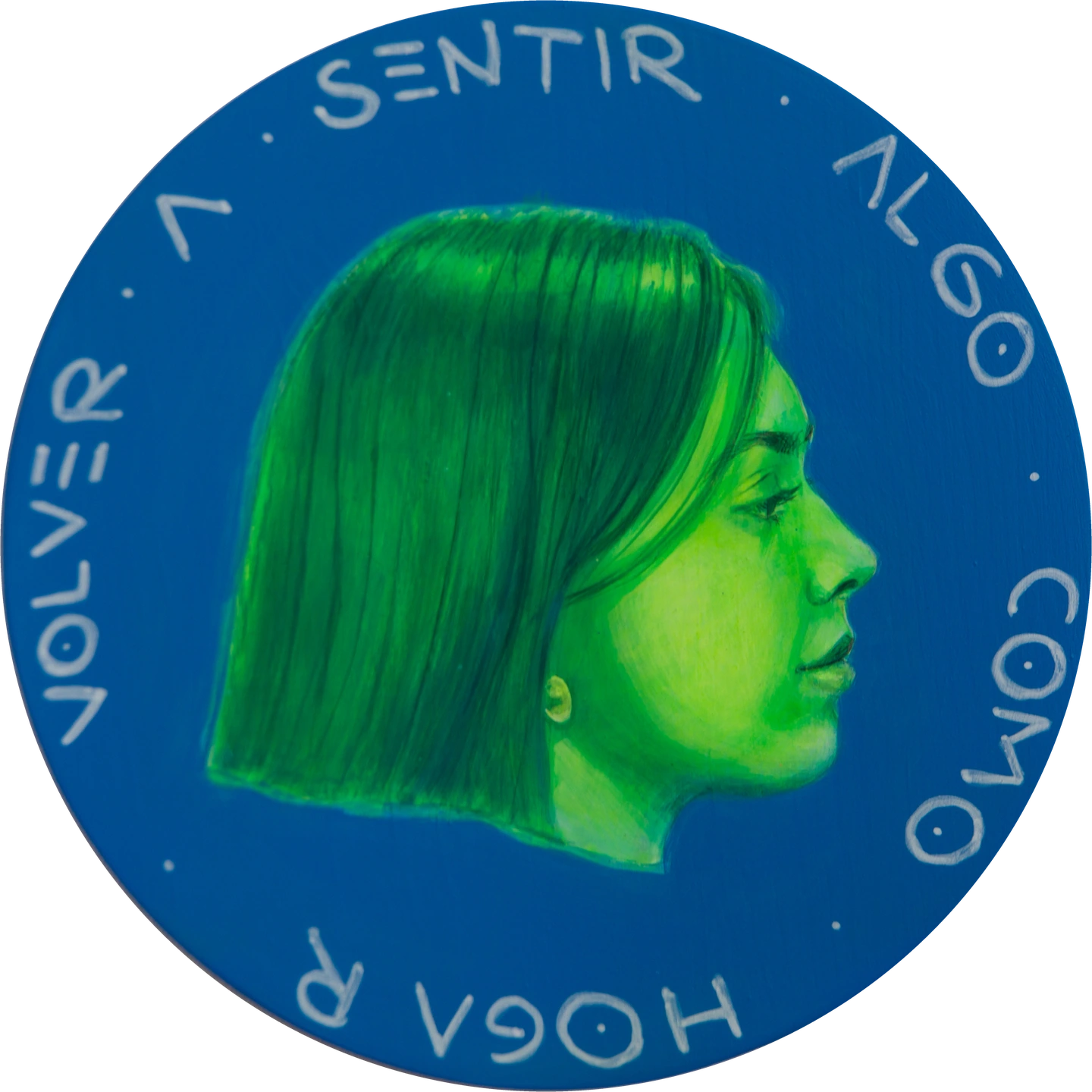
The story of Andrea Carolina Story · installations and exhibitions: LSYTSDA Sala Alterarte
Position · 0:00 / 10:36 SubtitlesOff ES EN GL Transcript 0:00 My name is Andrea Carolina. I come from Colombia. 0:03 I'm originally from there, born in Valledupar. 0:07 I grew up in Bogotá and Cúcuta, 0:08 a city on the border with Venezuela. 0:11 I lived there until I was eighteen: in 0:15 Bogotá until thirteen, then in Cúcuta until eighteen. 0:20 The journey came about because of insecurity in the country. 0:25 The decision was because of insecurity and the 0:28 economy, which was very bad at that time 0:31 and probably still is. 0:35 I came with my family, all four 0:40 of us. I've been here three years. 0:45 It's not long, but it's been partly 0:48 good and partly bad. Obviously I miss 0:51 my country, which means everything. I'm not prepared 0:56 to move back, but I would visit, 1:02 for holidays and nothing more. Coming here was a project 1:06 of almost two years, about a year and a half, 1:10 to raise the money, because flights 1:13 from Colombia to here are very expensive, 1:17 and to sort out paperwork and everything, so 1:22 we could arrive reasonably well, so to speak. 1:26 Illegally, but reasonably well. 1:29 Now I'm here, 1:33 fine, as normal. Many 1:37 people, many Spaniards, treat you well, while others are 1:42 a little racist and xenophobic. 1:46 I remember I was sixteen and 1:49 wanted to carry on studying in Colombia, 1:53 go to university, graduate and have a foundation for leaving the country. 1:58 But things got worse in terms of safety, because in the last 2:03 place I lived in Colombia there was a 2:06 lot of human trafficking, and they kidnapped many 2:09 women, girls like me at the time, many people 2:13 I knew. There were also the FARC and 2:17 the guerrillas. They placed bombs on the 2:21 road I took to school. It kept 2:26 getting worse. It was awful; luckily nothing happened to me or 2:30 my family. One day, talking with 2:33 my mother, the two of us 2:36 decided to look for another country to move to, somewhere outside 2:40 Latin America, because it isn't the 2:44 safest place in the world. We considered 2:47 the United States or Spain, and 2:50 chose Spain because of the language, naturally, 2:53 and because reaching the United States would mean 2:57 going through the Darién jungle or getting a visa, 3:00 which is a very long and difficult process. 3:04 Between us we made that small decision, 3:07 as if to say, "Let's see if it 3:11 works out." Then we discussed it with my 3:15 brother's father, who was there at 3:18 the time, and he said yes. 3:23 We started saving, in quotation marks, because in Colombia, with the 3:28 economy as it was, saving was very difficult. 3:34 We did what we could, giving up many things and 3:39 treats, until about a year and a half later, 3:44 when we had to take out 3:47 quite a large bank loan to 3:50 buy the flights and come here. We bought 3:54 them in March, I think, and came 3:57 in April. We arrived on April sixteenth, my 4:01 brother's birthday. We came to the town because 4:04 my mother had a friend here who could 4:07 take us in, because we had nowhere 4:10 to stay. We stayed for a month, then 4:14 moved into the flat where we live now. 4:17 The customs and language were a 4:20 little difficult. People speak Spanish, but many 4:23 also speak Galician. Sorting out paperwork and all that is quite a difficult 4:28 process. Although my mother did most 4:31 of it, it's hard to understand because 4:34 you're coming from just one language. 4:39 I started upper secondary school 4:45 to finish it here, but it's very different from what you study in Colombia. 4:50 Some things are more advanced and harder. I 4:53 couldn't manage, I felt overwhelmed and left. 4:57 Then I started vocational training. I'm 5:00 now finishing the intermediate Administration course. 5:03 I'm already doing work experience and graduate in June. My brother 5:08 had the hardest time, because he started primary school at 5:12 seven and has experienced quite a lot of bullying during this time for being 5:18 Colombian and for 5:23 having darker skin… The 5:27 way of learning 5:32 is very different from Colombia. But now 5:35 things are good for him and my 5:38 family; things have improved a lot. 5:40 It's hard to leave your life in your 5:44 country, to adapt again and feel something like 5:47 home. I think it's possible, but it's 5:50 quite a long process; I won't say 5:53 otherwise. It depends on you… I don't know 5:58 how to explain it. I think yes, 6:03 I'm starting to feel it's home, because I've been here quite a while, I know 6:08 people, and things are gradually improving. 6:12 My family is doing very well. 6:16 As long as my family and I are doing well, I think so. 6:20 It's a little hard being a foreigner. 6:24 Sometimes you feel set apart from everyone else, as though society doesn't accept you. 6:29 That's how you feel. Not anymore, 6:32 but during my first year here 6:35 I felt residents' xenophobia towards you 6:39 for being foreign. You don't feel 6:43 you belong there or here; 6:47 you feel in limbo. 6:50 It's unpleasant, but you learn 6:54 that you have to adapt to things. 6:57 It's a little strange in that sense, 6:59 feeling set apart, feeling rejected by others. 7:04 As far as I remember, I never held 7:08 back from going to the doctor. It wasn't 7:12 as though I was always ill or had to go every week. 7:14 But when I needed to, I went 7:18 to emergency care as normal. At that 7:22 time, three years or two and a half 7:25 years ago, you did see immigrants in 7:28 hospital, but I always saw that 7:31 as normal. I didn't feel rejected 7:35 or held back from going because I was foreign. 7:39 Safety is very different from Colombia. 7:43 It's a radical change. 7:46 It's one of the reasons I wouldn't move back to Colombia: 7:48 safety. 7:49 Going out alone here as a woman would have been unthinkable there. 7:53 And I was younger there, like meat for the lions, 7:58 so to speak. 8:00 Here, safety and the economy are very good, 8:03 going out with your family, being able to 8:05 hold your phone in your hand, something so simple, 8:08 because in Colombia you can't do that in the street. 8:11 You have to put it away or you'll get robbed. 8:14 Going out at night as a 8:17 woman is also unthinkable there, unless 8:20 you're in a group, with men 8:25 or with your family. Safety 8:30 is the most important thing, I think, and the economy too. 8:34 Here a minimum wage stretches, so to speak, 8:38 to many things. There it barely covers anything, 8:43 to live, to more or less survive. 8:46 That's what has 8:49 changed most drastically. 8:52 I'm not moving back to Colombia. I'd like 8:56 to visit, but for now it isn't in my 8:59 plans, even in the future, to live there again. 9:01 I want to keep studying, finish vocational training, 9:05 then a higher qualification and university if I can. 9:09 I want to work, specialise in what 9:12 I do and continue living in Spain. 9:14 I'd like to move to a bigger city. 9:19 And specialise in marketing, which is what I'm planning to study. 9:25 Travel, discover Spain's many beautiful places, 9:31 and travel around Europe, specialise here and visit other countries. 9:37 But I'm not moving back to Colombia. 9:40 To myself… I don't know. Back then I 9:43 was more innocent, so to speak. Here 9:47 I learned to be more streetwise. To 9:52 my mother, before coming, if I had 9:56 a time machine, I'd tell her to be strong and not give up, though she 10:00 hasn't. To be strong, because of 10:04 the many situations we've lived through here, 10:07 so many difficult changes. And to myself, not 10:10 to believe everything, and to be strong too, 10:14 because if I'd been a little stronger, I think I would have achieved more 10:19 in the three years I've been 10:23 here. Not to give up, which I 10:28 have done with some things.