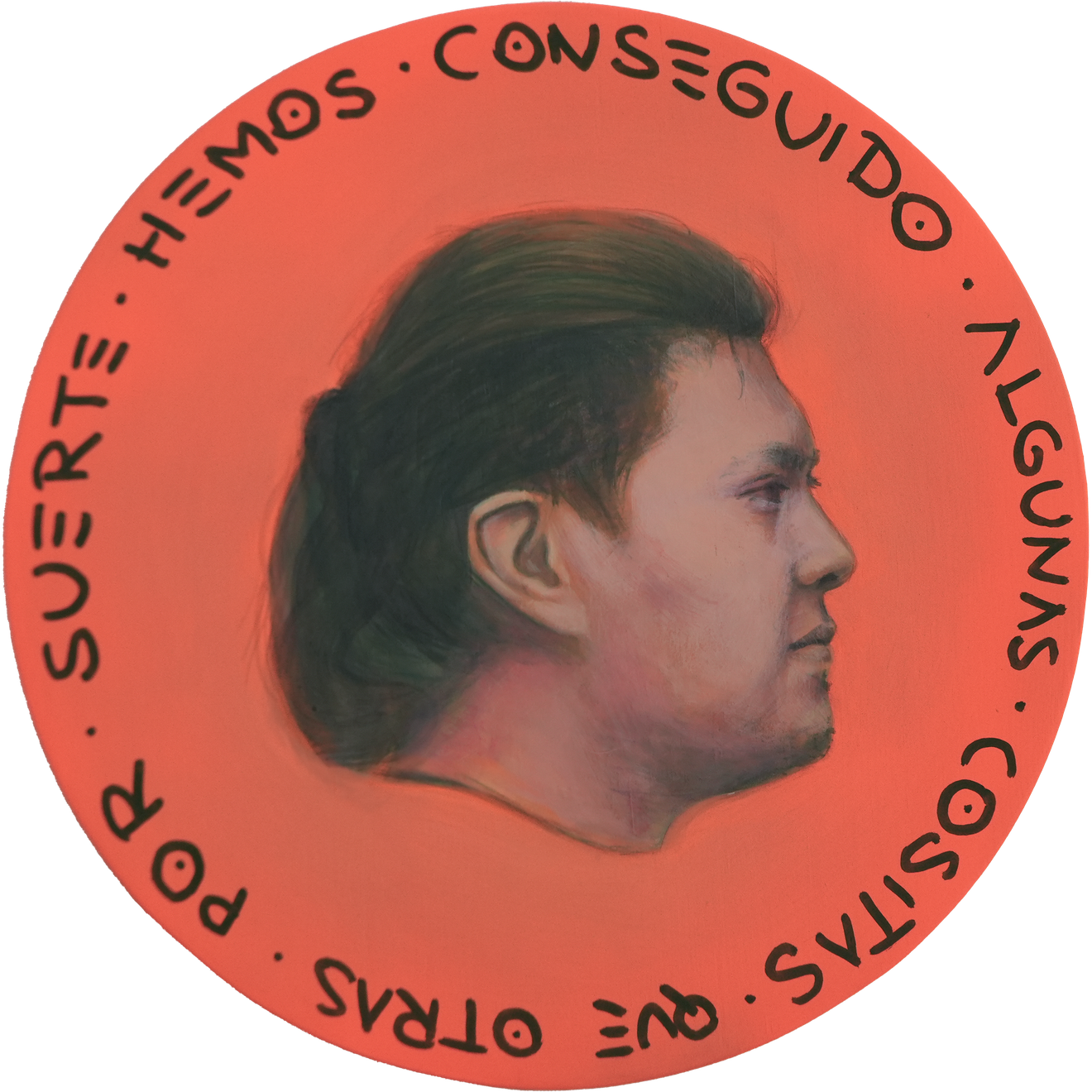
The story of Joe Story · installations and exhibitions: LSYTSDA Sala Alterarte
Position · 0:00 / 7:47 SubtitlesOff ES EN GL Transcript 0:00 Well, I'm Joe Sebastián Castro Carrasco. I'm from Peru. 0:05 I'm twenty-five, and I was born in 0:09 the city of Ayacucho. It's quite similar 0:13 to Ourense, actually, the weather and everything. I've been here 0:18 for almost a year; in July it will be a year 0:22 here. This place means a new 0:26 opportunity for me, where I can develop 0:31 different abilities that I hadn't been able to develop in Peru, for various reasons. 0:36 Initially, this project began with about a year 0:41 in Malta, to earn 0:45 some money by working, because 0:48 my aunt lived there and helped 0:52 us with the paperwork. We had 0:55 planned to stay there for one or two years. Once we'd reached 1:00 the goal we needed to come here, we decided to 1:03 come to Spain so I could study, along with 1:05 my cousin and my mum. We're the ones who left Peru. When we arrived 1:11 in Spain, the difficult thing at first 1:15 was finding somewhere to stay. To get 1:20 a room or a flat, they asked for 1:24 so much paperwork, like payslips, to rent 1:28 a flat for two. It was quite 1:32 difficult, but luckily we managed to get 1:36 a few things sorted out here 1:40 and there. In the end, 1:43 we found a solution, also with 1:47 the help of relatives with whom we'd 1:50 lost touch. We got back in touch after arriving in Spain; they lived 1:54 here. 1:55 The change was difficult. In 2:00 Peru, we often say our 2:05 family is a little unusual because 2:08 my grandfather had got us used 2:11 to all living together. For my mum, my 2:14 cousin and me to leave that circle, 2:17 as it were, was quite an abrupt change. 2:21 It was a shock to start managing 2:24 on our own, without an uncle, a cousin or a grandfather 2:29 saying: what's wrong? Do you have this 2:32 problem? Come on, I'll help you. Things 2:35 like that. 2:36 To get it out of the way, I'm 2:40 terrible at numbers, dates and all that, 2:43 so I couldn't tell you anything about those. But 2:48 I have a T-shirt my grandmother gave me years ago. It really should be thrown away, 2:54 but because she gave it to me and 2:58 I was very attached to it, I said no, 3:02 I'm bringing it, even if everyone objects and says: leave it, it's torn, 3:06 it has holes, it looks awful. I keep it as a memento. 3:11 As for how I 3:15 feel, I would say 3:19 I'll never stop feeling Peruvian, because that's where 3:23 I come from. I was always taught 3:27 to value where you come 3:31 from. When I introduced myself 3:35 to Tomás at the start of the course, I mentioned 3:38 cuy. It was a joke for everyone else, but for me 3:42 it was a way to remember where I come from, because in my hometown 3:46 that particular dish is 3:51 very common. Of 3:55 course, that doesn't mean 3:59 I can't adapt to this new 4:03 environment. Although I'm Peruvian, I have to 4:06 respect the places I go and the people I'll be living alongside 4:10 there. 4:12 Honestly, yes, I'd say it was 4:15 my decision. In Peru, I reached 4:19 a point where I felt stuck, 4:22 where I wasn't moving forward personally 4:25 or professionally. So the idea of 4:29 leaving the country to look for something 4:34 more came up, and I said yes, let's go. As 4:38 I said, I came with my mum and my cousin, 4:41 but much of my family stayed there: my aunts, my cousins 4:46 and many people I know. But 4:49 I don't feel I've lost them, 4:53 because I'm still in touch with them. I 4:56 call when I remember, and so on. 5:00 To answer the first question, I 5:03 think being a foreigner is like 5:06 being a guest. When someone invites you into their home, 5:11 you have to respect the rules there. Then, little by little, 5:17 you adapt to the surroundings, to 5:19 the way the place works. 5:23 As for the comments you 5:27 mentioned, negative or positive, honestly, 5:30 I don't really mind. I don't feel 5:34 they'll affect me personally. If they're about 5:38 my cousin or my mum, then I pay more 5:41 attention, because I think about how they might feel. 5:43 If someone insults me or says something 5:46 to me, I don't mind. I can 5:50 live with that. I know 5:53 those comments can, in 5:57 a way, be ‘justified’, in 6:01 quotation marks, by certain individuals who come and 6:05 don't do the right thing. But I'd say 6:10 I can understand them to some extent, because in Latin America we also 6:15 have a problem with immigration, and 6:18 there are those two sides. 6:22 In principle, yes, I plan to stay, but of course 6:26 I'll go back to Peru to visit my family. 6:31 I do plan to go back from time to time. 6:34 Exactly where I'll live, I haven't the faintest idea. 6:38 I like Ourense because it's 6:42 quiet. I like quiet places. 6:46 I've always said I'm an old man in 6:49 a young person's body, because I like being peaceful, 6:51 with no one bothering me, the rain and all that. I'm happy. 6:57 I don't tend to think much about 7:01 the future. I prefer enjoying the present. 7:06 What would I tell them? To take 7:12 the risk. Things can go wrong, even terribly 7:17 wrong, but they can go well too. 7:23 It's always about taking a risk. That's life, 7:27 after all. As they say, nothing ventured, nothing gained. 7:31 You can lose too, but that's 7:35 part of the risk. And that's it.