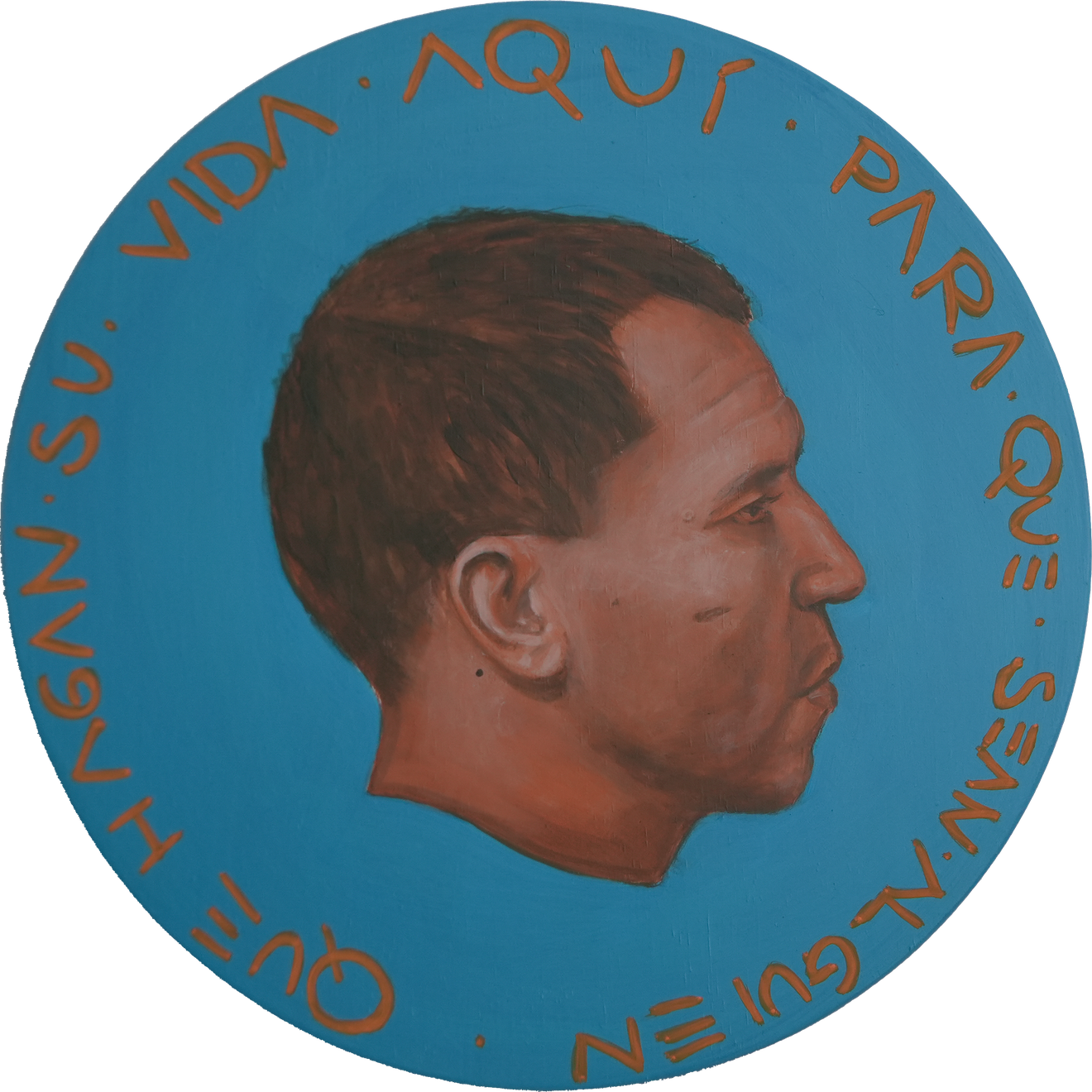
The story of José Antonio Story · installations and exhibitions: LSYTSDA Sala Alterarte
Position · 0:00 / 9:23 SubtitlesOff ES EN GL Transcript 0:00 Hello. My name is José Antonio Mendoza. 0:03 I'm from Venezuela, from the state of Sucre. 0:08 I'm 27. What does Venezuela mean to 0:12 me? It means a lot. My parents grew up 0:16 there, as did my siblings and I. My parents 0:19 are alive, thank God. I have a wife 0:24 and two children. What made me emigrate? 0:31 I emigrated because the situation in 0:35 the country is very serious. The wages 0:39 you earn aren't enough for anything. You work 0:42 for a week and your wages cover 0:45 food for two or three days. 0:48 One of my children is in school, 0:52 the other is three. My father is 0:55 sixty and my mother is almost fifty. 0:58 Besides supporting my own family, 1:00 I also have to help my parents, 1:03 even though there are many of us siblings. 1:07 I identify strongly with my country, 1:09 because I lived there for twenty-seven years and have many friends. 1:15 I didn't want to leave, but because of the economic 1:18 situation in Venezuela, 1:20 I had to do it for my children's wellbeing. 1:23 Besides, the country isn't safe. 1:26 It's far too unsafe. 1:28 Yes, I travelled alone. I've been here a 1:33 month and twenty days. I have a 1:37 cousin here who helped me come and has supported me while 1:42 I've been here. 1:42 I'd already spoken to my cousin, who knew about the situation in Venezuela. 1:47 I asked whether she could help me leave 1:50 the country, thinking of my children's wellbeing. 1:54 For example, I've finished secondary school. 1:58 But I thought: if I study for a 2:01 degree and spend two or three years at university, 2:06 your work isn't valued, because the wages aren't enough for anything. 2:10 To me those were three lost years, because during those university years 2:15 I could work and help my parents. 2:17 In Venezuela, when I arrived there, 2:20 immigration stopped me and sent 2:23 anti-drug officers to accompany me. They 2:26 put me through X-rays two 2:29 or three times. Here in Spain, thank God, I 2:31 arrived and they asked where I was coming from, 2:34 and everything was normal, thank God. 2:40 What motivated me most was thinking that I 2:43 couldn't see a future for my children there. 2:47 Thinking about their future, I don't want them to go through what I did, 2:50 spending a lifetime studying and then not being able to do anything. 2:54 Venezuela isn't safe at the moment. 2:58 For example, last year, in the part of Venezuela where I live, 3:02 the government entered houses without a 3:05 search warrant or anything, searching them. 3:10 They even entered the school, with so many 3:12 children there. At that moment my child was 3:15 in class. According to them, they were following someone who 3:20 had gone in, but the workers and teachers say no one 3:25 had entered, that the gate was closed. Those videos are on social media; 3:29 you can look for them and find them. 3:31 It's not easy. My child, 3:34 especially the youngest, is very 3:37 attached to me. Wherever I went I took them both, especially him, because 3:42 he slept with me. He would wake up in the night and, if I wasn't beside him, 3:45 he would lie down with me. I was with them all the time. I don't speak much, 3:50 on the phone… Every time I speak, they start saying that 3:54 they want to come, and I start crying. I don't want to… It hasn't been 3:59 easy. I haven't spent that much time away from my parents 4:04 either. The longest time apart was when I turned eighteen and 4:09 went to serve the government for 4:13 two years. The longest I've spent away 4:17 from them is six months. I've always been with my parents, and it wasn't easy 4:20 leaving them alone either. 4:21 Yes, sometimes I feel a little out of place. Sometimes people say things that 4:25 I don't understand. I don't ask; they say something and I don't ask again. 4:30 I say "okay" without knowing what they said. I'm worried the person 4:35 might say, "He doesn't understand me." For example, when they speak slowly, 4:38 I understand Galician people a little, but sometimes they speak fast 4:43 and I'm stunned; I don't understand anything. 4:47 Just like in the part of Venezuela I come from: 4:50 we speak fast. 4:52 They say I speak too fast too, and they don't understand me. 4:54 I have to speak slowly. I'm starting to understand things: 4:57 I know I can't speak so fast, 4:59 I have to slow down a little so they can understand me. 5:01 But I feel good. The people I've dealt with 5:06 treat me warmly and give me confidence. 5:10 Yes, I feel good here, comfortable. 5:14 I don't feel as out of place 5:18 as elsewhere. But there are people who sometimes, at weekends, when 5:24 they're drinking, pass by 5:26 and say offensive things 5:29 to you. It's happened to me about twice, but I take it as normal, because 5:35 I understand they're people under the influence of alcohol and 5:40 don't know what they're doing. 5:42 Yes, they say we come here to take 5:46 their jobs. They insult me, but it's normal, 5:50 because I understand. 5:53 It's not normal to leave your country. If it's doing well economically, nobody leaves. 6:00 Everyone would stay in their own country. Though many ask why we're 6:05 leaving if Venezuela is doing well… 6:09 But the same people remain. What they did was remove 6:13 the president, while his whole group stayed. The country is still the same. If 6:19 Venezuela were doing well, 6:22 I really wouldn't have left. 6:25 You work for a week… Personally, I earned fifty dollars 6:31 a week in Venezuela, and it's not the same. 6:35 My aim when I left was… 6:38 I spoke to my wife and said, "I'm going to go, 6:40 and I'll make every effort I can to work and save, 6:44 and try to move my paperwork along so 6:48 I can have a more stable stay there, 6:51 for example, getting residency, something like that, 6:55 so I can bring my wife and my two children over." 6:58 If the country allows it and approves my stay here in Spain, I see myself 7:04 bringing my family over and living here for a long 7:06 time. I want my children to build their lives here, 7:08 to grow and become someone in the future. 7:11 If I could go back in time, I'd tell myself: 7:15 "Why didn't I do it earlier?" Some time ago I'd had 7:21 the chance to leave and always said 7:24 no, worrying about what people would say. 7:28 I kept wondering whether it would go well or badly. I decided to go because I said: 7:32 "If I leave and it goes well, that's welcome. If it goes badly…" 7:36 You enjoy successes; you learn from mistakes. 7:41 Instead of constantly wondering whether to leave, it's better to take the risk. 7:46 Things that are meant to happen will happen. 7:50 If I'd made the decision earlier, 7:54 I don't think I would have reached the situation I was in. 7:56 Yes, I feel I'm on the right path, always 7:59 asking God to guide me. I said to him: 8:03 "If you give me the opportunity to leave Venezuela for the country you 8:06 put in my mind, it's because you have something in store for me." 8:12 Since I began praying to God, I don't know if it was God 8:16 giving me a little sign, my eldest child started saying he wanted… 8:22 Without knowing, without us mentioning it, he said, "Spain." 8:25 "Spain, Spain." A while after he started saying that, my cousin 8:29 gave me the chance to come, saying she would help me. 8:33 I said, "Lord, if you're putting this in my path, there must be a reason." 8:36 I decided to come. 8:39 When I first arrived 8:42 here, someone said… 8:48 What was it they said? 8:49 "Venga." "Venga" meant I should go. 8:52 They said "venga" and I turned around, running back to the person calling me. 8:56 They said, "What?" 8:59 What did they say? 9:00 What did they say after "venga"? 9:01 That it meant "bye," like saying goodbye. 9:03 They said "venga" and I ran back. 9:05 Apart from that, everything is normal. 9:10 So far I've liked it here, yes.